THKT8200: Master of Professional Practice
Academic Supervisors & Assessment Leads: Studio Practice Lead & Academic Committee
This course unit forms the core investigative spine of the Master of Professional Practice degree. Focusing on non-representational photographic interventions, the research bridges chemical darkroom processes with post-digital optical glitching to challenge conventional notions of photographic transparency.
Key aims include:
- Developing an autopoietic material methodology across silver gelatin and scanographic substrates.
- Synthesising critical theory (Flusser, Barthes, Krauss, Steyerl) with experimental studio outputs.
- Curating and archiving exhibition-ready visual portfolio plates and rigorous exegesis chapters.
Assessment Tasks & Grading Weights
1 TASKS SCHEDULEDAssessment 1: Methodological Framework & Initial Body of Work
Submission of initial studio photographic experiments demonstrating chemical intervention and substrate friction, accompanied by a methodological research paper.
Linked Creative Practice & Studio Artworks
2 ARTWORKS SUBMITTED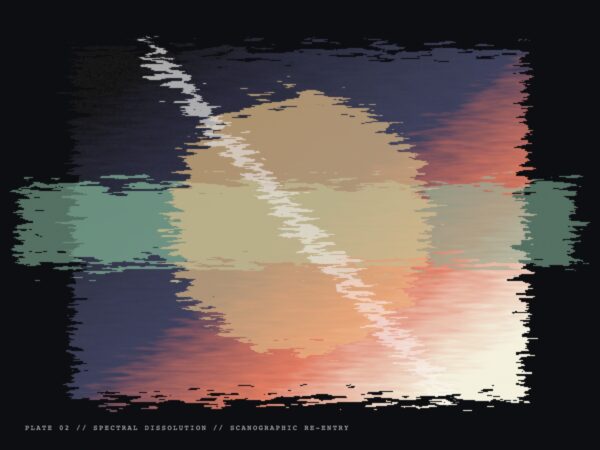 PLATE 02
Spectral Dissolution: Re-Entry
Multi-pass linear scanography, mechanical sensor friction, prism refraction
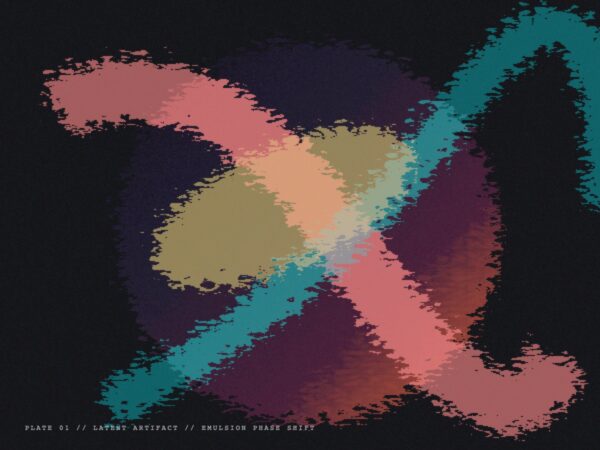 PLATE 01
Latent Artifact: Emulsion Phase Shift
Silver gelatin, potassium ferricyanide bleaching, flatbed shear
Linked Exegesis Writing & Field Documentation
1 DOCUMENTS CONTRIBUTEDAgainst the Transparent Window: The Glitch as Material Evidence
Deconstructing Alberti's pictorial window through scanographic drag and buffer fragmentation, arguing for an autonomous non-representational ontology.